⌁
Mobile T-Hunts
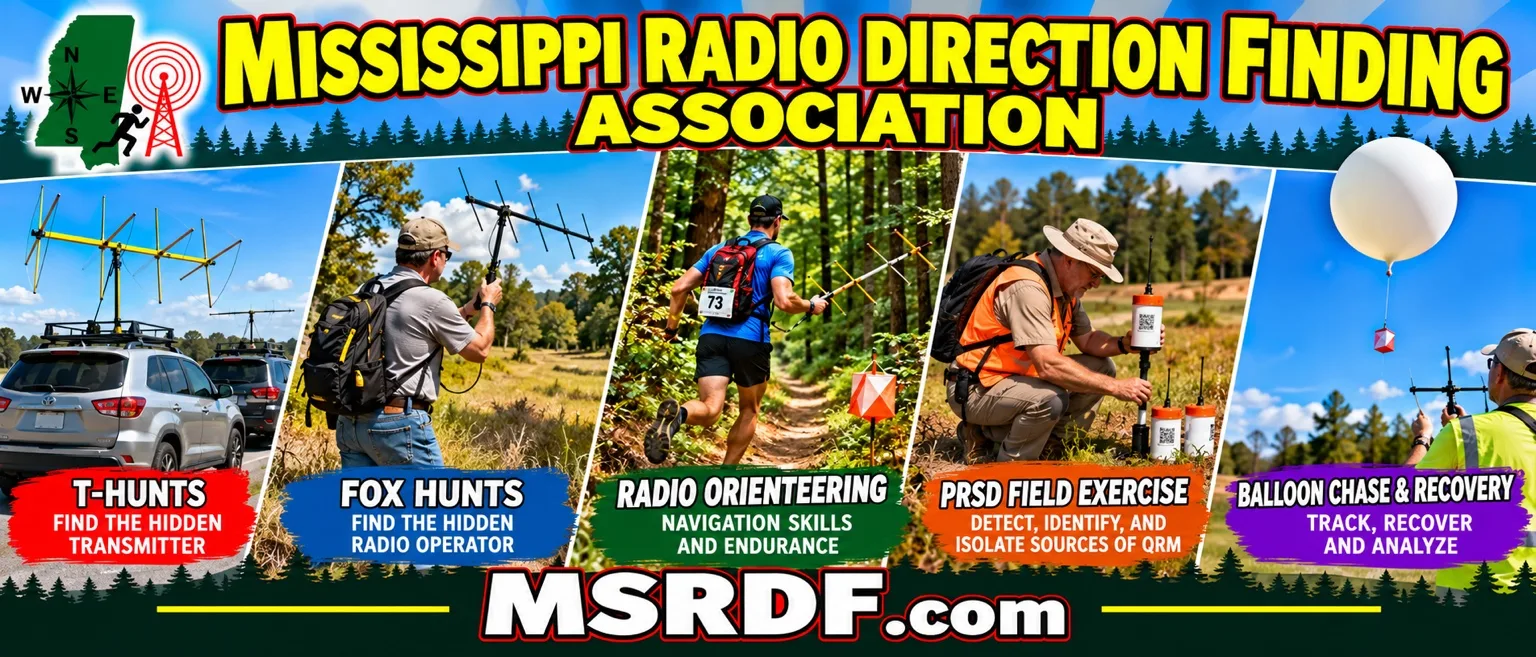
Most of the search is conducted from vehicles. Hunters travel through the Hunt Boundary and stop periodically to take radio bearings, compare signal strength, and choose the next direction of travel.
Once the signal has been narrowed to a small area, the final part of the hunt is completed on foot. The transmitter is often visible from the vehicle, but not always. It might be at the base of a tree or up in the branches. It might be under a bush, or attached to a fence post. In an urban area it might be behind a sign, or magnetically stuck to a metal object.
After finding it, hunters record the find by scanning its QR code with Hunt Manager or by signing a paper logbook when electronic verification is impractical.
↟
Pedestrian T-Hunts
The entire hunt is conducted on foot. Participants carry their radio direction finding equipment while working their way toward the transmitter.
Walking distances depend on the size and terrain of the advertised Hunt Boundary. A Pedestrian T-Hunt may take place in a park, at an event site, or in another area suitable for a complete on-foot search.